:quality(80))
:quality(80))
:quality(80))

How can we help you?
)
craftworks GmbH
Schottenfeldgasse 20/6a
1070 Vienna
A government directive temporarily took Fable 5 offline. Access is back. But the business question remains: What is your fallback plan when external rules change overnight?
:quality(80))
Know-How
reading time: 7 min
Simon Grabher
:quality(80))
AI has moved past the proof-of-concept phase. Large language models now handle code migrations, technical analysis, and multi-step operational workflows. Tasks that used to require dedicated teams and weeks of turnaround now sit inside development pipelines, support contracts, internal tooling, and customer-facing processes. They're embedded in how teams work.
That kind of adoption happens fast and quietly. A department tries a tool, finds it useful, builds a process around it, and six months later that process runs on infrastructure the company doesn’t operate, doesn't audit, and didn't formally procure. The dependency is real before anyone has stopped to examine it. And most companies, when they do examine it, find they're running consequential business processes on systems they have no control over.
Anthropic positioned Fable 5 as a model built for demanding, long-running, agentic tasks. Exactly the kind of work that makes AI valuable in production. Code analysis, complex engineering support, process automation, research, knowledge work.
Only days after release, access was suspended. Anthropic cited a US government export-control directive tied to national security, requiring the company to restrict access for foreign nationals. Because the order took effect immediately and nationality could not be reliably verified in real time, Anthropic suspended Fable 5 and Mythos 5 for all users.
The models were later restored after the export controls were lifted and additional safeguards were implemented. That update matters. It shows that the issue was not permanent unavailability, but dependency on decisions outside the company's own control.
For companies that had already started building around the model, the consequence was the same during the outage. The model was gone. Not because of a bug. Not because of pricing. Because of geopolitics, security concerns, and regulatory intervention.
This is what it looks like when frontier AI is treated as strategic infrastructure. Political decisions, security assessments, and export rules can now reach into the availability of software your teams depend on. A model can be technically available, commercially attractive, and operationally useful on a Monday. Then temporarily inaccessible on Friday.
Companies routinely treat them as the same thing. But they're not.
Access means your team can reach the model through an API, a web interface, or a cloud platform.
Control means you know where your data flows, which models process which tasks, what gets logged, how outputs are validated, and what happens when a provider makes a change you didn't ask for.
That distinction matters most in manufacturing, energy, automotive, pharmaceuticals, mechanical engineering, and critical supply chains. AI in these environments handles sensitive data, production decisions, quality checks, and safety-relevant workflows. When those processes run on external systems you can't audit, you've added a risk layer that doesn't appear on any org chart.
The concern is that companies lose the ability to react. When a provider disables a feature, updates a data retention policy, replaces a model, or requires new identity verification from your engineers, you find out after it's already in effect.
Anthropic's recent identity verification rollout shows how quickly platform conditions can shift. In certain situations, users may be asked to verify their identity with a government-issued ID and, in some cases, a live selfie before accessing specific capabilities.
Anthropic states that this verification data is used to confirm identity and is not used for model training. That distinction is important. But it does not remove the governance issue for enterprises. It shows that access requirements, data flows, third-party processors, and safety controls can change at the platform level. Sometimes faster than internal policies, procurement processes, or security reviews can react.
At the same time, model improvement and data retention remain separate but relevant questions. For consumer products, chats and coding sessions may be used to improve models if users allow it, and that data may be retained in model training pipelines for up to five years. For certain highly capable "covered models", even some commercial or zero-data-retention configurations may require limited retention and review for safety purposes.
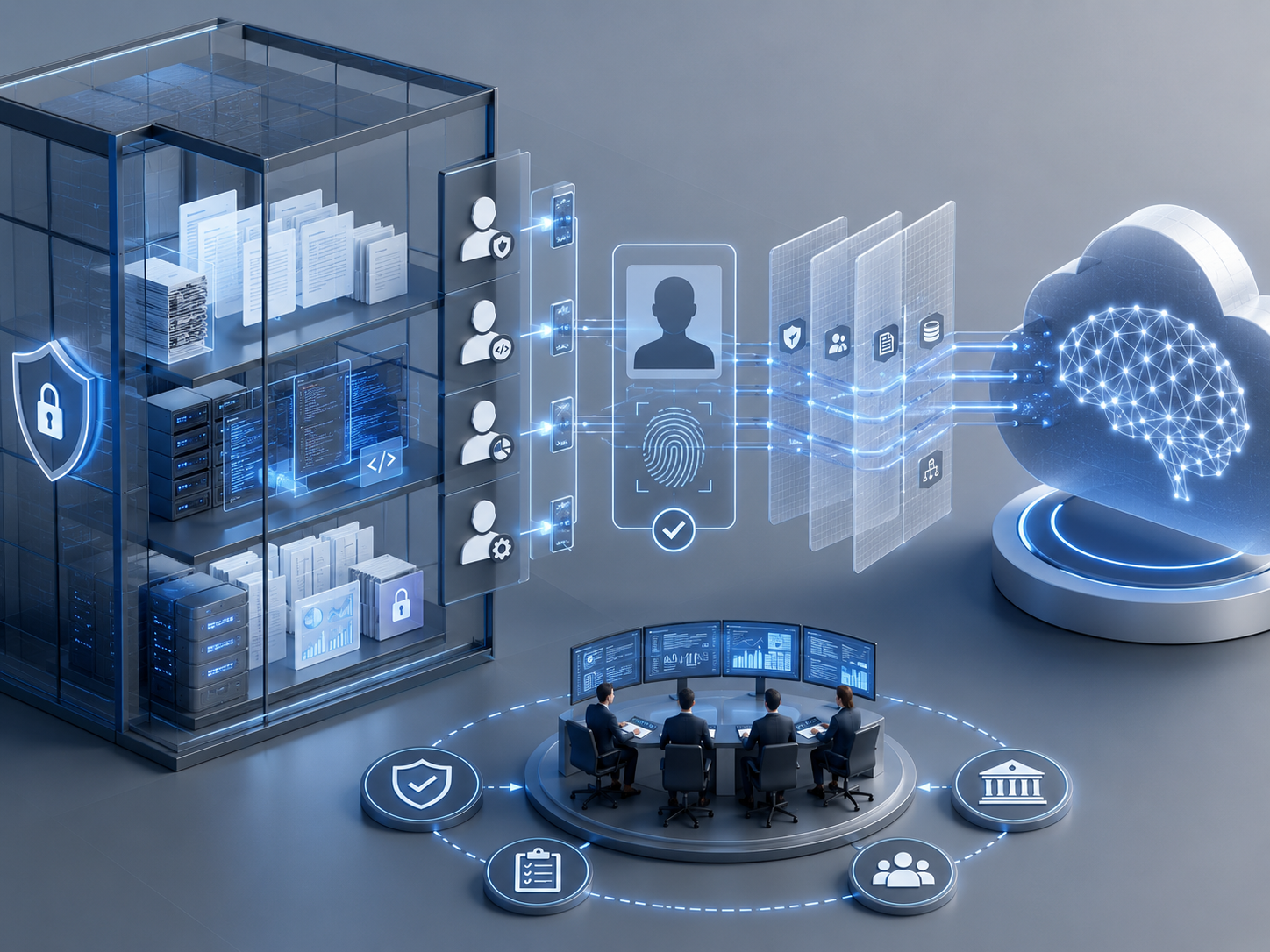 From a consumer standpoint, these may look like account settings. From an enterprise standpoint, they are governance questions.
Which data is safe to run through external AI systems?
Which prompts contain confidential technical specifications?
Which code is business-critical?
Who in the organization is authorized to use which models?
How do you keep sensitive material out of training, feedback, safety review, or retention pipelines?
Usage policies don't answer these questions. Architecture does.
Building your own AI system does not mean training a frontier model from scratch. For most companies, that would be unnecessary and uneconomical.
It means building a controlled layer between your business processes, your data, and the models you use.
That layer defines what enters the system, what stays inside, what is sent to external services, which model is used for which task, how outputs are checked, how decisions are logged, and how the company can switch providers if needed.
In practice, this can look very different depending on the use case.
A manufacturer might run a private AI system that analyzes production data and machine behavior without sending sensitive operational data to consumer tools.
An engineering team might use AI assistance for documentation and code review while keeping critical repositories inside controlled environments.
A quality team might deploy AI models for anomaly detection or visual inspection directly in the production context, with clear logging, model monitoring, and retraining processes.
An operations team might use agentic workflows that interact with ERP, MES, or maintenance systems. But only through defined interfaces and approval logic.
The goal is control, resilience, and accountability.
Most companies are still approaching AI as a tooling question: Which model is best? Which assistant should we use? Which subscription should we buy?
Those questions matter, but they are not enough. Once AI becomes part of productive workflows, the more important questions are architectural.
Where does data flow? Which information may never leave the company? Which AI capabilities are business-critical? What happens if a model changes, becomes unavailable, or is restricted by regulation? Can the company switch models without rebuilding the entire process? How are outputs evaluated? Who is responsible when AI-assisted decisions affect operations?
This is the difference between using AI and being ready for AI.
AI readiness means that companies can integrate AI into real processes without creating uncontrolled dependencies. It means they can benefit from external innovation without handing over operational agency. It means they can choose models, providers, and deployment patterns based on the specific risk profile of each use case.
Controlled AI systems need more than prompts and interfaces. They need the same operational discipline that companies already apply to other critical systems.
Data pipelines must be reliable. Access rights must be clear. Models need to be versioned, monitored, and evaluated. Outputs need to be logged. Performance needs to be measured over time. Retraining must be planned. Security and compliance requirements must be built into the system, not added afterwards.
This is where MLOps becomes essential.
MLOps provides the structure to deploy, monitor, and improve AI models in production. It helps teams move from isolated experiments to repeatable, auditable, and scalable systems. In industrial environments, this is especially important because AI is not only interacting with documents or chat interfaces. It is often connected to machines, sensors, cameras, production lines, planning systems, and quality processes.
Without architecture, AI remains a tool. With architecture, AI becomes infrastructure.
craftworks helps companies build AI systems that are not only powerful, but operationally reliable, secure, and aligned with real business processes.
We bring long-standing experience in data engineering, machine learning, industrial software, MLOps, anomaly detection, predictive maintenance, predictive quality, generative AI, and visual inspection. Our work focuses on turning AI from isolated experiments into productive systems that can be integrated into existing IT, OT, and process landscapes.
With navio, craftworks provides a platform for managing, deploying, and monitoring machine learning models in production environments. With navio VISION, we bring AI-based visual quality control to industrial use cases, enabling companies to detect defects, generate structured inspection data, and improve production quality in a controlled setting.
Beyond products, craftworks supports companies in identifying the right AI use cases, designing data and model architectures, building secure interfaces, implementing monitoring, and preparing AI systems for long-term operation.
The goal is not to replace every external model or avoid every cloud service. The goal is to make sure that the company decides how AI is used. Not the other way around.
The Anthropic Fable case is not only a story about one model, one provider, or one government directive. It is a signal for a broader shift.
AI systems are becoming more powerful, more regulated, and more closely tied to questions of national security, data governance, and digital sovereignty. At the same time, companies are integrating AI deeper into their workflows, often faster than their governance structures can adapt.
That gap creates risk.
Companies that rely only on external access remain exposed to external decisions. Companies that build controlled AI architectures gain options. They can protect sensitive data, manage model risk, switch providers, define their own governance, and keep business-critical processes under their own control.
Digital sovereignty starts with owning the architecture of being AI-ready.
:quality(80))