:quality(80))
:quality(80))
:quality(80))

How can we help you?
)
craftworks GmbH
Schottenfeldgasse 20/6a
1070 Vienna
AI-based EOL quality control catches defects, reduces reclamations, and gives management real data.
:quality(80))
Know-How
reading time: 9 min
Bianca Peiu
:quality(80))
In most manufacturing operations, the final visual inspection before shipping is the last chance to catch a defective part. This end-of-line (EOL) quality control step carries enormous weight. Everything that passes it goes to the customer. Everything it misses becomes a reclamation.
Yet in many factories, this step still depends entirely on manual quality inspection. An operator checks each part visually, decides OK or not-OK, and moves on. In some operations, quality control and packaging are combined into a single step, the same person inspects the part and prepares it for shipping. The longer someone performs this combined task, the more the error rate increases. Fatigue builds. Attention drops. And not-OK parts slip through.
The consequences are predictable. Manufacturing leaders hear the same complaints in quality reviews: "How many defective parts did we actually ship last month?", "Why do inspection results vary between shifts?", "Why do we only discover manufacturing defects after customer complaints?", "Why can we not trace which defects came from which line or batch?".
These questions point to two problems at once. First, manual inspection at end of line misses too many defects. Second, when defective parts escape, the process produces no structured data to explain what happened or prevent it from happening again.
AI-based quality control addresses both. It catches more defects before they ship, and it turns every inspection into structured production data. navio VISION, developed by craftworks, brings automated quality inspection and visual anomaly detection directly into the production line, at end of line, and increasingly at earlier process steps too.
The core frustration for production management is concrete. It starts when a customer receives defective parts that should have been caught during final inspection, even in environments where systems like navio VISION are not yet in place to ensure consistent detection.
When this happens, the cost is not just the return itself. It triggers a reclamation, the customer demands replacement parts, the production line may need to run a new batch, and for lines that produce different products, switching back to reproduce a specific part is especially costly. Reclamation management becomes a significant hidden cost that grows every time a not-OK part reaches the customer.
A second cost often goes unnoticed. It is the burden on the customer's incoming inspection. When a supplier ships inconsistent quality, the customer responds by increasing their own QA efforts on incoming parts. That drives up their costs, damages the supplier relationship, and can lead to lost contracts. Reducing the QA effort on the customer side for incoming parts is one of the most valuable but least visible benefits of better end-of-line detection, and a key outcome when navio VISION is implemented effectively.
These gaps appear across manufacturing industries, from automotive to electronics to medical devices. They all trace back to the same structural limitation. Manual quality inspection at end of line was designed to sort parts into OK and not-OK. It was not designed to produce the kind of structured quality data that production management needs for reclamation management, root cause analysis, or AI transparency into what actually happens on the line.
Quality managers describe a common pattern. Defect rates are estimated from samples instead of measured across full production. Documentation varies between shifts and operators, not because of negligence, but because manual logging depends on the time and attention of one person. Management sees the full picture only weeks after production, long after defective parts have shipped, something navio VISION addresses by providing continuous, real-time inspection data.
The American Society for Quality reports that quality-related costs typically run between 15 and 20 percent of sales revenue. In some cases, that figure climbs to 40 percent of total operations. The Institute of Industrial and Systems Engineers places the range at 5-35% of sales, with an average around 15%.
For manufacturers shipping physical products, two cost drivers stand out.
Reclamations: Every defective part that reaches a customer may need to be produced again. On production lines that run different products, this is especially expensive. Switching the line back to produce a specific replacement batch costs setup time, material, and capacity that was planned for other orders. The hidden costs of reclamations go far beyond the price of the replacement part itself, costs that navio VISION helps prevent by catching defects earlier and more consistently.
Customer-side QA burden: When a customer receives inconsistent quality, they increase their own incoming inspection effort. More inspectors, more sampling, longer receiving times. This cost falls on the customer, but the supplier pays for it in a different way: through damaged trust, tighter contractual requirements, and eventually lost business.
Both cost drivers trace back to the same root cause. Not-OK parts passing through end-of-line quality control undetected.
But the costs also multiply inside the factory. Rework happens on the production floor every day. Parts get re-ground, re-coated, re-measured. Without structured inspection data linking specific manufacturing defects to specific process steps, the rework cycle repeats. The quality team fixes symptoms. The process that produced the defective parts keeps running.
The numbers confirm what management experiences. Research published in Human Factors journal shows that manual visual inspection in manufacturing typically achieves 70-80% accuracy. That means inspectors miss roughly 20-30% of defects. For every 100 defective parts on a production line, 20 to 30 pass inspection and move toward the customer.
This is not a training problem. It is a human factors problem. Fatigue, task monotony, lighting conditions, shift length, and individual variation all affect how many not-OK parts get through. Research published in The International Journal of Advanced Manufacturing Technology shows that operators performing repetitive inspection tasks experience measurable performance drops as mental fatigue builds, especially during extended or late shifts.
When quality control and packaging are combined into a single step, as they are in many operations, this effect is even stronger. The operator is doing two tasks at once. Assessing quality and preparing for shipment. The cognitive load increases, the inspection becomes less focused, and defect detection weakens over time. Studies in automotive manufacturing confirm that workplace and organizational factors directly affect how many defects inspectors catch.
 A common response to rising reclamations is to add inspection stations or increase sampling rates. Some organizations run second and third passes on the same batch.
This may catch more defects in the short term. But it does not reduce manual inspection costs, it increases them. Each extra inspection pass adds labor, slows throughput, and introduces another layer of subjective judgment. More importantly, the defects it catches still get logged the same way: manually, inconsistently, and without the structure needed to identify why those parts were defective in the first place.
Manual inspection produces a pass/fail decision. It does not produce timestamped, categorized, traceable data. Without that data, production management cannot identify which defects are recurring, which process steps produce the most not-OK parts, or whether the problem is getting better or worse over time. navio VISION turns every inspection into a structured data point.
This is why manufacturers serious about reducing reclamations reach the same conclusion: the inspection process itself needs to catch more defects and generate structured production data, both at the same time. That is where quality control automation with AI comes in.
AI-based quality control adds a consistent, data-generating layer to the end-of-line inspection process. It complements the judgment and experience of quality teams with structured, automated defect detection. The principle is straightforward, even if the underlying technology is complex.
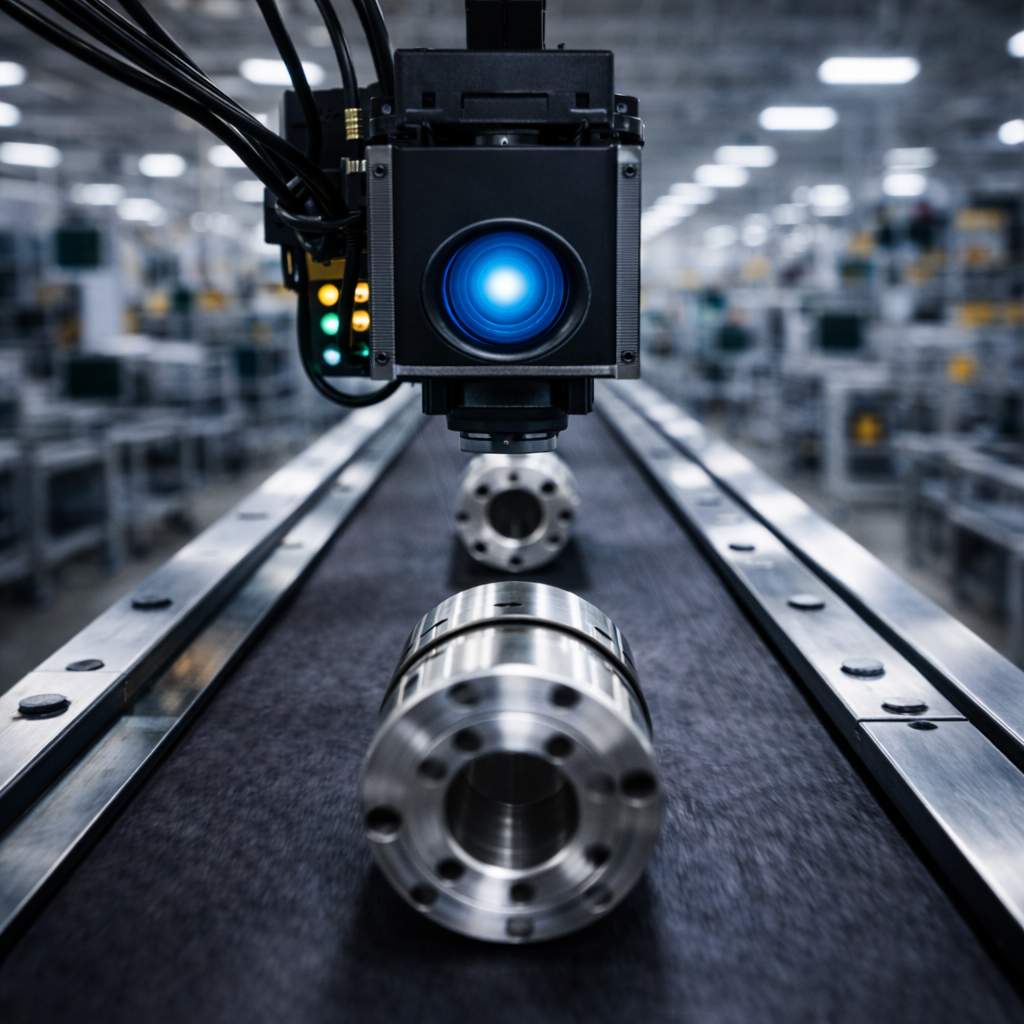
A camera captures an image of every part at the end-of-line inspection point. An AI model, trained on images of both acceptable and defective items from the specific production process, evaluates each image in milliseconds. It classifies what it sees: acceptable or defective. If defective, it identifies the type of visual anomaly. Every decision gets logged with a timestamp, an image, a classification, and a confidence score.
This changes end-of-line inspection from a gate (pass or fail) into a data source (what happened, when, where, and how often).
Three characteristics matter most for AI manufacturing quality control:
Consistency: The AI model applies the same criteria to every image, every unit, every shift. It is not affected by fatigue, shift timing, or the natural variation between individual inspectors.
Speed: Automated quality inspection runs at production speed. This means it can check 100% of output rather than relying on sampling.
Traceability: Every inspection event gets recorded as structured data, immediately available for analysis and reclamation management.
What AI-based inspection does not do is equally important. It does not replace the quality team. It does not remove the need for process engineering, root cause analysis, or continuous improvement. What it does is give those teams complete, consistent, structured quality data for every inspected part.
End-of-line quality control is the last resort. It catches defects before they ship, but by the time a part reaches the end of the line, all the production costs have already been spent. The material, the machine time, the labor from every upstream step, all of it is sunk.
This is why visual inspection applied earlier in the production process delivers even greater value. The earlier a not-OK part is detected, the less waste it creates. A surface defect caught after the first machining step costs far less than the same defect caught after five more steps of processing, coating, and assembly.
In complex production lines with multiple parts and steps, this matters enormously. A faulty component that enters an assembly undetected may cause the entire assembly to fail at end-of-line inspection. Instead of scrapping one part, the manufacturer scraps a complete unit or worse, ships it to the customer and faces a reclamation.
navio VISION supports visual anomaly detection at multiple points in the production process, not just at the end. By placing camera-based AI quality control at critical process steps, after forming, after welding, after coating, after assembly, manufacturers can catch defects where they originate. Each detection point reduces the number of not-OK parts that reach the next step, and each step avoided means costs saved.
The end-of-line inspection then becomes the final confirmation in a chain of automated checks powered by navio VISION. This is how quality control automation scales across an entire production line.
navio VISION, developed by craftworks, is built for industrial environments where two problems need to be solved at once: too many defective parts getting through, and too little data to understand why.
navio VISION connects directly to cameras on the production line, at end of line, at in-process checkpoints, or both. It runs images through AI models trained on the manufacturer's own products and defect types. No two production processes are identical. navio VISION accounts for this by letting teams retrain models on their own data, so the navio VISION learns what "good" and "bad" look like for each specific process.
The first result is immediate. More not-OK parts get caught before they ship. Reclamations drop. Customer-side QA burden decreases. The AI model inspects every unit at production speed with the same criteria, shift after shift.
The second result is structural. Every inspection produces data. Every result gets logged, categorized, and made available in real time. Quality managers and plant leaders see not just a defect count, but a structured breakdown, which defect types are appearing, on which line, during which shift, at what frequency, and how that compares to previous periods. This is the kind of AI transparency into production quality that manual processes cannot deliver.
This combination, fewer defective parts shipping plus complete quality data, is where the management complaints raised earlier get addressed directly.
"How many defective parts did we actually ship?" With navio VISION, the defect rate is measured continuously and automatically, not estimated from samples. Management sees the actual number in real time.
"Why do inspection results vary between shifts?" The AI model applies the same criteria regardless of time, operator, or shift. If one shift is producing more defective parts, the data shows it clearly.
"Why do we only find problems after customer complaints?" navio VISION flags defects the moment they occur. If a process starts drifting out of specification, the data shows it immediately, before defective products reach packaging. This shifts reclamation management from reactive to proactive.
"Why can we not trace which defects came from which line?" Every inspected unit is recorded with its image, classification, and timestamp. When a customer reports a manufacturing defect, the team can trace it back to the exact point in production, in minutes, not weeks.
navio VISION applies across industries and inspection scenarios. A few examples show the range:
Energy production: AI-powered maintenance tool verification confirms that the correct tools are present and properly arranged before critical procedures. This prevents costly errors that manual checklists often miss.
Electronics manufacturing: Automated assembly kit verification checks that every component is correctly placed before assembly begins. This catches omissions and mix-ups that time-pressured visual inspection routinely overlooks.
Healthcare: Surgical instrument verification uses AI-based image analysis to confirm that instrument trays are complete and correctly configured before procedures. This is a safety-critical application where manual checking is both slow and error-prone.
Manufacturing: Scrap detection and surface defect detection identify manufacturing defects in real time during production, both at individual process steps and at end of line. This replaces sampling-based inspection with continuous, line-speed quality monitoring.
Solar production: Assembly verification and automated quality control check that cell positioning, soldering, and encapsulation meet specification across every panel. This is critical for both product performance and warranty compliance.
Packaging: Automated packaging inspection with ERP integration connects the visual inspection output directly to the production management system. This closes the loop between defect detection and production planning and directly supports reclamation management.
 The most direct benefit is fewer defective parts reaching customers. When AI catches not-OK parts that manual inspection misses, reclamations drop, customer complaints decrease, and the costly cycle of replacement production slows down. For lines producing different products, fewer reclamations means fewer unplanned batch switches, a significant cost saving.
But the value goes further. The structured data that navio VISION generates changes how quality teams and production management operate.
Faster root cause analysis. When defect patterns become visible, quality teams find root causes faster. Instead of spending days tracing a customer complaint through production logs, the team can see when a defect pattern started, on which line, and link it to process changes or material batches. Problems that used to take weeks to diagnose now take hours.
Lower cost of poor quality. Scrap and rework costs drop as detection improves, especially when visual inspection is applied at earlier process steps, not just at end of line. Customer returns decrease as fewer defective units leave the facility.
Reduced customer-side QA effort. When a supplier consistently ships higher quality, the customer can reduce their incoming inspection effort. This strengthens the supplier relationship, lowers the customer's operating costs, and creates a measurable competitive advantage.
Management confidence. When the data is reliable, quality reviews become productive conversations instead of arguments about whose numbers are right. When a customer calls about a defective part, the team can pull up the inspection record within minutes. Audits become straightforward because the inspection trail is complete and digital.
McKinsey's annual research on AI in manufacturing shows that organizations applying machine learning are significantly more likely to improve key performance indicators. Industry reporting from Quality Magazine confirms that detection AI vision systems are the most developed AI use case in AI manufacturing quality control today. Early adopters are seeing measurable results in automated defect detection and operational efficiency.
Manual visual inspection has served manufacturing for decades. The people performing it are skilled and experienced. But when too many defective parts still reach customers despite a functioning inspection process, the issue is structural, not personal.
Customer expectations around quality keep rising. A single shipment of defective parts can damage a relationship that took years to build. Reclamations are expensive, especially on multi-product lines where reproducing a specific batch means unplanned changeovers. Regulatory requirements for traceability keep tightening. Production volumes grow while experienced inspection staff become harder to find and keep.
The question facing manufacturing leaders is not whether their inspection team is doing a good job. In most cases, they are. The question is whether manual end-of-line quality control can stop enough defective parts from shipping and produce the data needed when one does get through.
AI-based visual inspection does not replace the quality function. It strengthens it. navio VISION catches more manufacturing defects, generates complete quality data for every inspected part, and gives management the visibility to act before not-OK parts become reclamations. Applied at end of line, it is the last resort that actually works. Applied earlier in the process, it catches defects where they cost the least to fix.
The technology is mature and the evidence is clear. The remaining question is how long an organization can afford to keep shipping parts it cannot fully account for.
See navio VISION in action. Try the demo to explore how AI-powered visual inspection works in real production environments and what your quality data looks like when every inspection is captured, categorized, and available in real time.
:quality(80))